Ever wondered why your dog ignores that bright red toy, or why your cat seems unimpressed by colourful accessories? The answer lies in how your pet sees the world.
Your pet doesn't see the world the way you do, and once you understand how their eyes work, a lot of their "weird" behaviour suddenly makes perfect sense. Let's take a fun, eye-opening walk through how your pet sees colours and what that means for everyday play, training, and bonding.
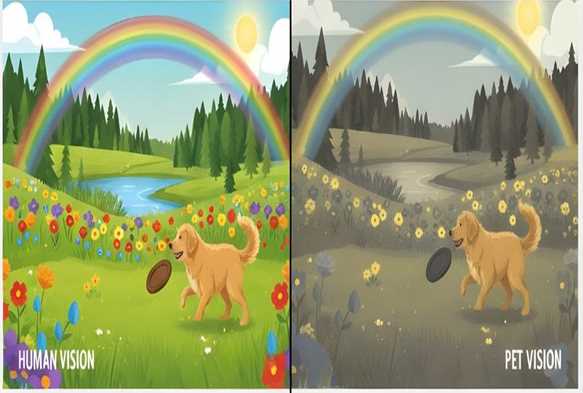
Do Pets See Colours or Only Black and White?
Pets do see colours, but not the full range humans see. Dogs and cats are not color-blind in the traditional sense. Instead, they see a limited spectrum of colours, with reduced brightness and saturation.
Their vision prioritises:
-
Movement
-
Contrast
-
Low-light visibility
Colour accuracy is secondary. This is why pets respond faster to a moving object than a brightly coloured one.
How Dogs See Colours
Dogs see mainly blues and yellows. Dogs have two types of colour-detecting cells (cones) in their eyes, while humans have three. Because of this, dogs experience a narrower colour range.
What colours can dogs see clearly?
What colours can dogs not distinguish well?
To a dog, red usually appears as dark grey, brown, or black, depending on lighting. This is why a red toy on green grass often blends into the background.
Can Dogs See Red?
Dogs cannot see red as red.
Red appears dull or dark to dogs, not bright or eye-catching. However, this does not mean dogs cannot see a red object at all; it simply looks less vivid.
A dog's visibility depends more on:
-
Lighting
-
Movement
-
Contrast
Why Do Dogs Still Play With Different Colour Toys?
Dogs don't choose toys based on colour. They choose them based on instinct.
A dog plays with a red toy because:
-
It moves when thrown or tugged
-
It makes sound (squeaks or crinkles)
-
It smells familiar (often like you)
-
It's associated with fun and reward.
For dogs, motion, smell, and sound matter far more than colour. That's why a red toy can still be a favourite, even if the colour itself isn't clearly visible.
How Cats See Colours Compared to Dogs
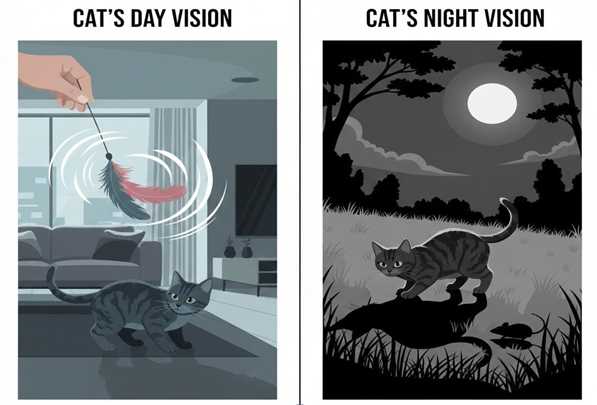
Cats see fewer colours but detect movement exceptionally well.
Cats can distinguish:
They struggle with:
However, cats have:
-
Excellent night vision
-
High sensitivity to contrast
-
Superior motion detection
This explains why cats are more reactive to shadows and movement than colourful objects.
Do Cats Care About Colour at All?
Colour is one of the least important senses for cats.
Cats rely primarily on:
-
Motion
-
Shape
-
Light changes
This is why a simple moving feather excites a cat more than a bright toy sitting still.
Why Pet Vision Is Different From Human Vision
Pets are evolved for survival, not visual aesthetics.
Their eyesight is developed to:
-
Spot prey quickly
-
Navigate in low light.
-
React instantly to movement.
Seeing every shade of the rainbow was never necessary. That’s why pets experience the world as a blend of muted colours, strong contrasts, and dynamic motion.
What This Means for Pet Parents
Understanding how your pet sees colours helps you:
-
Choose toys that your pet notices faster
-
Improve training response
-
Reduce frustration during play
Final Takeaway
Your pet doesn't see the world in bright reds and greens. They see it through motion, contrast, and instinct.
Contact Mr n Mrs Pet to understand your pet better. MMP takes care of your pet's every need, be it adoption, grooming, training, hostel, vet care, or mating.